

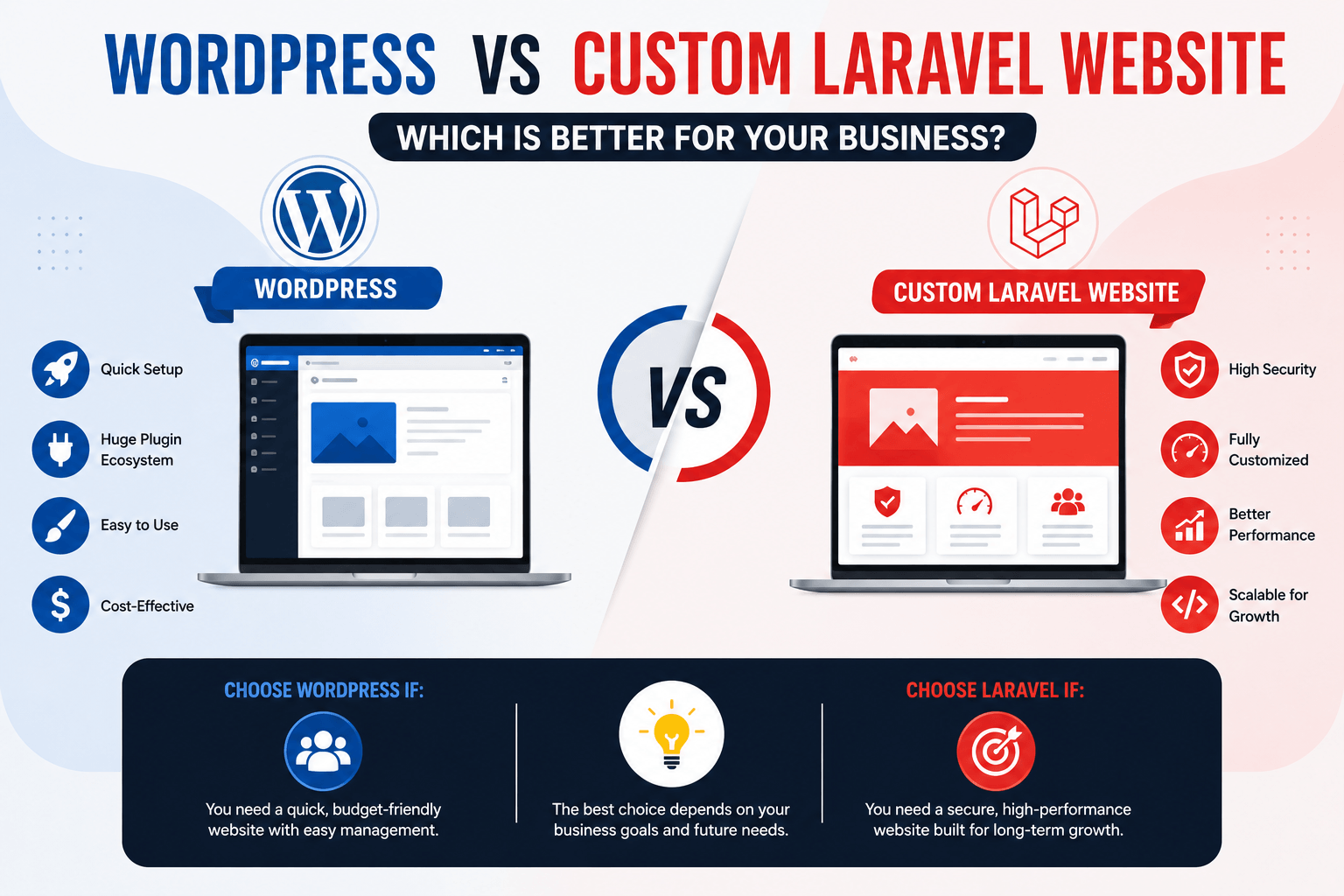
Choosing the right technology for your business website is one of the most important decisions in 2026. Two of the most popular options are WordPress and Custom Laravel Development. Both are powerful, but they serve different business needs.
If you're planning to build a business website, eCommerce platform, web application, or custom portal, understanding the differences between WordPress and Laravel can help you make the right investment.
In this guide, we’ll compare WordPress vs Custom Laravel websites based on performance, flexibility, cost, security, scalability, and more.
WordPress is the world’s most popular content management system (CMS). It allows businesses to create websites quickly using:
WordPress is ideal for:
Laravel is a powerful PHP framework used for building fully custom web applications and advanced websites.
Unlike WordPress, Laravel development is coded from scratch, allowing developers to create:
Laravel offers complete flexibility and performance optimization.
| Feature | WordPress | Laravel |
|---|---|---|
| Development Speed | Faster | Longer |
| Customization | Moderate | Unlimited |
| Performance | Good | Excellent |
| Security | Depends on plugins | Strong custom security |
| Scalability | Limited for large systems | Highly scalable |
| SEO | Excellent | Excellent |
| Maintenance | Easier | Requires developers |
| Best For | Small to medium websites | Advanced custom platforms |
| Cost | Lower | Higher |
| Flexibility | Plugin-based | Fully custom |
WordPress allows businesses to launch websites quickly using ready-made tools and templates.
Benefits include:
Perfect for businesses needing a quick online presence.
Laravel development takes more time because everything is built custom.
However, it provides:
Ideal for businesses requiring unique systems or complex features.
WordPress customization depends heavily on plugins and themes. While flexible, certain advanced features can become difficult to manage.
Too many plugins may also affect:
Laravel offers unlimited customization possibilities.
You can build:
without relying on third-party plugins.
WordPress websites perform well when properly optimized. However, excessive plugins and heavy themes can slow down websites.
Laravel applications are generally faster and more optimized because developers control the entire system architecture.
Laravel is better for:
WordPress is secure, but plugin vulnerabilities are common if websites are not maintained regularly.
Businesses must:
to stay protected.
Laravel provides strong built-in security features such as:
Custom Laravel websites are generally safer because they rely less on third-party tools.
Both WordPress and Laravel can be highly SEO-friendly.
WordPress offers excellent SEO plugins like:
making SEO setup easier for beginners.
Laravel allows developers to create fully optimized SEO structures manually for maximum performance and control.
Both platforms can rank well on Google when optimized correctly.
WordPress works great for:
But large-scale systems may eventually face limitations.
Laravel is designed for scalability and handles:
much more efficiently.
Lower initial development cost because:
Best for businesses with smaller budgets.
Laravel development costs more because:
However, it offers better long-term flexibility and scalability.
✅ You need a quick website launch
✅ Your budget is limited
✅ You want easy content management
✅ Your website requirements are simple
Best for:
✅ You need advanced custom features
✅ You expect long-term scalability
✅ Security is a major priority
✅ You want complete customization
Best for:
Both WordPress and Laravel are excellent technologies, but the best choice depends on your business goals.
Before choosing, consider:
A professional development team can help you select the right platform for your business success in 2026.



